
A practical guide to valuing the property, reading the sales campaign and deciding when to negotiate—or walk away.
There is no reliable rule that says you should offer 5% below the asking price—or a set amount above an “Offers Over” figure. The right offer depends on the property’s value, its advantages and risks, buyer competition, the seller’s circumstances, and how the agent runs the campaign.
Brisbane properties are also sold in several different ways. If you are unsure how Offers Over, fixed-price, auction and deadline campaigns differ, start with our guide to how properties are sold in Brisbane.
The short answer: estimate the property’s fair market value using recent comparable sales, adjust for condition and location, then consider competition and seller motivation. Set an opening offer and a firm walk-away price before negotiations begin. |
Don’t Confuse the Asking Price with a Property’s Market Value
The advertised price is part of the sales strategy. It is not a reliable indication of what the property is worth or what the seller will accept.
An “Offers Over” figure shows where the agent has positioned the campaign. A property advertised at Offers Over $1.2 million might sell near that figure, well above it or, if interest is weak, below it. “Contact Agent”, “By Negotiation” and auction campaigns offer even less guidance.
Rather than asking, “How much below the asking price should I offer?”, ask, “What does the available evidence suggest this particular property is worth?”
Step 1: Estimate the Property’s Fair Market Value
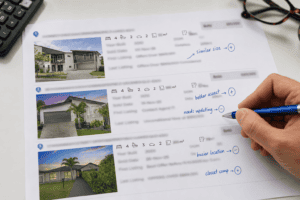
Start by identifying three to six genuinely comparable settled sales. The strongest evidence will share as many of these features as possible:
- The same suburb, neighbourhood or micro-location

- The same school catchment where this materially affects demand
- A similar property type, age and construction
- Comparable land and internal floor area
- Similar bedroom, bathroom and car accommodation
- Similar condition and renovation quality
- A comparable aspect, outlook and view
How Recent Should Comparable Sales Be?
Ideally, use sales from the past three to six months. However, a recent sale is not necessarily a good comparable. Consider whether market conditions changed during that period.
If prices or demand have moved, adjust older sales accordingly. In a tightly held pocket, you may need to look further back for a genuinely similar home. A strong comparable from nine months ago may be more useful than a poor match from last month, provided you account for the intervening market movement.
Comparable Properties Should Ideally Be Inspected
Where possible, you—or someone advising you—should have inspected the comparable properties. Listing photographs present homes favourably and may hide poor workmanship, awkward layouts, noise, privacy issues, limited natural light or unusable land.
Photos can also make rooms look larger and views more impressive. They rarely show how a property feels in person or how neighbouring homes affect its appeal.
If you did not inspect a comparable, speak with someone who did, such as the selling agent, a buyer’s agent, a building inspector or another experienced local professional. Two homes can look almost identical in a database yet feel—and sell—very differently.
Don’t Rely Solely on Automated Valuations
Automated estimates from Cotality/CoreLogic, PropTrack and lenders can be a useful starting point, but they do not replace an inspection and analysis of comparable sales.
An algorithm may miss renovation quality, poor workmanship, a superior outlook, legal-height issues, unapproved improvements, significant noise or rapid market changes. It can estimate the value of a typical property with similar data, but not always whether this home is one of the best—or worst—examples in the street.
Step 2: Adjust for the Property’s Strengths and Weaknesses
Once you have identified the best comparable sales, adjust for differences between those properties and the one you are considering. Factors may include:
- Renovated versus unrenovated condition, including the quality and age of the work
- Land size, shape, slope and usability
- Internal floor area, ceiling heights and layout
- Aspect, natural light, privacy, outlook and views
- Main-road, railway and aircraft noise
- Flooding, overland flow, drainage and retaining structures
- School catchment boundaries
- Legal-height living areas and unapproved building work
- Easements, underground infrastructure and planning controls
- Development or subdivision potential
- Pool, landscaping and outdoor living
- Surrounding properties and overall street presentation
For an apartment or townhouse, also assess the building, floor level, internal area, aspect, parking, visitor parking, body corporate costs, building condition and planned expenditure.
Step 3: Understand the Street-by-Street Advantages and Risks
Brisbane property values can vary significantly within the same suburb—and even the same street. One side of a road may offer a better aspect, less traffic noise, greater elevation or a different flood profile.
A risk does not always make a property unsuitable, but it may affect its value and resale appeal. The key is to identify and investigate the risk, then reflect it in the price.
This is one area where an experienced local buyer’s agent can add considerable value. Knowing the suburb is useful, but negotiations often depend on knowing why one pocket attracts a premium and why a seemingly comparable property is not truly comparable. Our Complete Search to Settlement service includes independent price assessment and property-specific due diligence.
Step 4: Assess the Current Level of Buyer Competition
Do not base your offer only on commentary about “the Brisbane market”. Competition varies by suburb, price bracket and property quality.
A renovated family house in a tightly held school catchment may receive several offers within days. An overpriced or compromised property nearby may remain unsold for weeks.
Look at inspection attendance, second inspections, written offers, building and pest inspections arranged by other buyers, days on market, price changes and the supply of similar homes.
Step 5: Understand the Seller’s Circumstances
Market value and the price a seller will accept are not always the same. A good negotiation considers both the property and the seller’s position.
Find out why the owner is selling, whether they have bought elsewhere, whether they need a particular settlement date and whether the property is vacant, tenanted or owner-occupied. Also ask whether previous contracts have fallen over or the property has been listed before.
If the Seller Has Already Purchased Elsewhere
Contract terms may matter more than the final few thousand dollars. A settlement date that suits the seller, dependable finance and confidence that the sale will complete may outweigh a slightly higher but less certain offer.
The highest price does not always win. If you can meet the seller’s preferred timing without taking on unacceptable risk, you may strengthen your offer without increasing the price.
Motivated Versus Aspirational Sellers
A motivated seller usually has a clear reason and timeframe for selling. They may engage with a well-supported offer and value timing or certainty alongside price.
An aspirational seller may simply be testing whether someone will pay well above market value. This is common with some off-market opportunities, where there has been no public campaign to test the price.
Is the Property On-Market, Pre-Market or Off-Market?
On-market property
The property has been exposed to the wider market. The seller can assess demand, while buyers can see how the campaign is performing. If interest is weak or the home has been listed longer than expected, there may be more room to negotiate.
Pre-market property
The seller is preparing to launch publicly unless they receive an acceptable early offer. Your offer may need to be strong enough for the owner to abandon the campaign and forgo wider competition.
Genuine off-market property
The owner may value privacy, speed or convenience. In that situation, a suitable settlement date and reliable terms can be almost as important as price.
An owner testing the market off-market
Some owners allow an agent to approach selected buyers but will sell only for an unusually high price. Assess the property independently and do not pay an unsupported premium simply because it is described as “off-market”.
For more detail, see our guide to buying off-market property in Brisbane.
Step 6: Research the Selling Agent
Sales agents use different processes. Understanding the agent can be almost as important as understanding the property.
Some agents negotiate verbally before preparing a contract; others require every offer on a signed contract. Some invite buyers to improve, while others call immediately for a best-and-final offer. Some sell regularly before auction; others prefer to proceed to auction day.
Review the Agent’s Previous Sales Campaigns
If you do not know the agent, review their recent listings. Check typical days on market, the original advertised price, campaign changes and the eventual sale price. For auction agents, note whether listings tend to sell beforehand, proceed to auction, pass in or enter post-auction negotiations.
Use property databases, current and archived listings, the agency website, auction results and the agent’s social media profiles. Reviewing several campaigns can reveal patterns in how the agent quotes, sets deadlines and negotiates.
For example, if an agent says a property will “definitely sell before auction”, it is useful to know whether that is consistent with their usual results—or simply part of the current campaign strategy.
Learn the Agents in Your Target Area
If you are buying without professional representation, attend local open homes and follow each campaign through to settlement. Record the agent’s price guidance and compare it with the result. Note whether they run several negotiating rounds, request one best offer or bring auctions forward.
Appraise every property you seriously inspect. Record your estimated range and predicted sale price, then check the result after settlement. Over time, you will learn which features attract a premium and how individual agents guide the market. You may eventually know the area well enough to consider becoming a buyer’s agent yourself. 😳
Step 7: Interpret What the Sales Agent Is Really Saying
Selling agents represent the seller and are engaged to obtain the best result. Interpret their comments in that context.
You may hear statements such as “there is a lot of interest”, “another offer is coming”, “the owners are deciding tonight”, “you’ll need to improve”, “you’re close” or “this will be sold before the weekend”.
These statements may be genuine updates, signals about the seller’s expectations or attempts to prompt action. They may also be vague because the agent cannot disclose another buyer’s price or terms.
Not every deadline is artificial and not every claim of competition is a bluff. Equally, general buyer enquiry is not the same as a signed competing contract. |
Your task is to decide what is meaningful, what remains unconfirmed and whether anything has changed since you set your limit.
How Experience Helps
An experienced buyer’s agent will consider the agent’s communication style, previous campaigns, days on market, rejected offers and whether inspection activity supports the claimed urgency.
Relationships with selling agents do not provide secret access to competing offers. They can support clearer communication, familiarity with the agent’s process and confidence that a prepared buyer can act quickly when the opportunity is genuine.
Step 8: Set Three Numbers Before Negotiating
1. Estimated market value
This is the range supported by comparable sales and your assessment of the property’s condition, location, advantages and risks.
2. Opening offer
This amount should reflect the campaign, seller’s circumstances and likely competition. It may sit below your assessed value in a one-on-one negotiation or near your limit in a genuine best-and-final process.
3. Walk-away price
This is the maximum you are prepared to pay. It may be slightly above market value if the home is exceptionally well suited to your long-term needs. If so, make that a deliberate lifestyle decision—not one made under pressure during a five-minute phone call.
How Much Below the Asking Price Should You Offer?
There is no universal percentage. The right approach depends on the property and campaign.
Situation | Possible approach |
Newly listed with strong interest | Make a credible offer supported by comparable sales. |
Overpriced with little buyer interest | Start below your assessed value and leave room to negotiate. |
Several written offers | Consider your strongest justifiable price and safest competitive terms. |
Seller has purchased elsewhere | Ask whether settlement timing and certainty matter more than a small price difference. |
Genuine off-market opportunity | Consider whether the seller values privacy, convenience or avoiding a public campaign. |
Owner testing for an exceptional price | Do not exceed fair value simply because the opportunity is off-market. |
Property requires substantial work | Obtain realistic cost estimates and allow for the work, inconvenience and risk in your initial offer. |
Do Not Assume You Can Renegotiate After Building and Pest
If the property clearly needs work, obtain realistic cost estimates and allow for them in your initial offer. Do not overpay on the assumption that you can renegotiate after the building and pest inspection.
The inspection is intended to identify defects and risks, not to create a second negotiation over issues that were apparent before signing. Renegotiation may be appropriate if the report reveals significant unforeseen problems, but do not rely on that outcome.
Should You Make Your Best Offer First?
In a one-on-one negotiation with little competition, it may be sensible to leave room to move. In a genuine multiple-offer process, you may have only one chance. Holding back $5,000 in expectation of another round could cost you the property.
Before participating, understand whether the agent is asking for an opening offer or a final one. Our detailed guide to buying property with multiple offers in Queensland explains the process in more detail.
How Much Should You Offer in a Multiple-Offer Situation?
Recheck the comparable sales before responding to competition. Ask whether the agent has received multiple written offers and whether this is the final opportunity to improve.
Set your walk-away price before revising the offer. Consider the whole contract, not just the price, and avoid repeated increases based on vague feedback. If another buyer is willing to pay more, walking away may be the right result.
A sound multiple-offer strategy will not win every property. It gives you a realistic chance while protecting you from a price you may regret.
Price Is Only One Part of a Strong Offer
Sellers may compare finance and building and pest conditions, the deposit, settlement date, possession or tenancy arrangements, any sale contingency and the likelihood that the buyer will complete.
An experienced buyer’s agent will usually try to identify these priorities before finalising the offer. If timing or certainty matters, it may be possible to improve the contract without simply adding more money. Learn more about our Expert House Price Negotiation service.
Should You Remove Conditions to Strengthen Your Offer?
Shorter finance or building and pest periods can strengthen an offer, but removing conditions may expose you to significant risk. Pre-approval is not necessarily final approval for that property.
Before making an unconditional offer, complete appropriate due diligence and seek advice from your solicitor or conveyancer and finance professional. Stronger terms are not worthwhile if the risk is beyond what you can comfortably carry.
The same caution applies to countdown-based bidding and offer systems. Our guide to online property auctions in Brisbane explains why the platform does not always tell the whole story.
How Much Should You Offer Before Auction?
A pre-auction offer usually needs to be strong enough for the seller to abandon the campaign and the possibility of competitive bidding. First establish whether the seller is open to an early sale and whether the offer must be unconditional.
Check whether the agent’s listings commonly sell before auction or proceed to auction day. Complete all necessary legal, building, pest and property due diligence before making an unconditional offer. Depending on the campaign, waiting for auction may provide more information or leverage.
For auction preparation and strategy, see Bidding at Auction in Brisbane or our Auction Bidding Service.
Why Being Able to Move Quickly Matters
A careful decision need not be slow. Ideally, have finance pre-approval, a solicitor ready to review the contract, access to building and pest inspectors, a clear brief, available deposit funds and a repeatable method for assessing comparable sales.
A buyer’s agent who knows the area, sales evidence and local agents can often complete the appraisal, due diligence and negotiation preparation quickly. This matters when a suitable home appears midweek and the seller plans to decide within 24 hours.
The objective is prepared speed—not rushed decision-making.
Common Mistakes When Making an Offer
- Applying a fixed percentage to the asking price
- Relying entirely on an automated valuation
- Selecting poor comparable sales or ignoring market changes
- Judging condition solely from listing photographs
- Ignoring aspect, outlook, views and street-specific risks
- Confusing general enquiry with competing written offers
- Assuming every deadline is false—or that every deadline is genuine
- Revealing your maximum budget too early
- Failing to investigate the seller’s circumstances
- Treating every off-market property as a bargain
- Planning to renegotiate known defects after building and pest
- Removing conditions without understanding the consequences
- Negotiating emotionally after missing several properties
When Is It Worth Using a Buyer’s Agent to Negotiate?
A buyer’s agent can be particularly useful if you are unfamiliar with Brisbane values, buying from interstate or overseas, facing strong competition or a short deadline, or unable to assess local risks confidently.
Professional representation may also help if you are emotionally attached to the property, lack time to research local agents or want someone independent to set and enforce the walk-away price.
Remaining at Arm’s Length From the Sales Agent
Direct conversations with the selling agent can weaken your position. You may reveal your maximum budget, how long you have been searching, properties you have missed, previous offers, preferred settlement terms or urgency to buy.
Once disclosed, this information is difficult to take back. A buyer’s agent creates distance from the negotiation, asking questions and testing the seller’s position without unnecessarily exposing the buyer’s budget, emotions or urgency.
What an Experienced Buyer’s Agent Contributes
A buyer’s agent cannot magically persuade a seller to accept less. The advantage comes from repeated experience: inspecting and appraising properties, understanding street-specific risks, dealing with local agents, recognising campaign strategies and knowing which questions to ask.
That experience may help you negotiate a lower price, secure the right property quickly, or have the confidence to walk away.
Worked Brisbane Offer Example
Consider a house advertised as Offers Over $1.2 million. Comparable sales indicate $1.18 million to $1.24 million. Its renovated kitchen and attractive outlook add value, but road exposure detracts from it, producing an estimate of about $1.21 million to $1.23 million.
Scenario 1: One buyer and a flexible seller
The buyer may open below the assessed range and retain room to negotiate.
Scenario 2: Several written offers and a final deadline
The buyer may submit their strongest justifiable offer, knowing there may be no further opportunity.
Scenario 3: The seller has purchased elsewhere
Settlement timing and certainty may matter more than obtaining the final few thousand dollars. A well-structured offer could succeed without being the highest.
Scenario 4: The owner is testing the market off-market
The owner may insist on $1.3 million or more. The buyer must decide whether the unsupported premium is worthwhile rather than assuming an off-market opportunity offers good value.